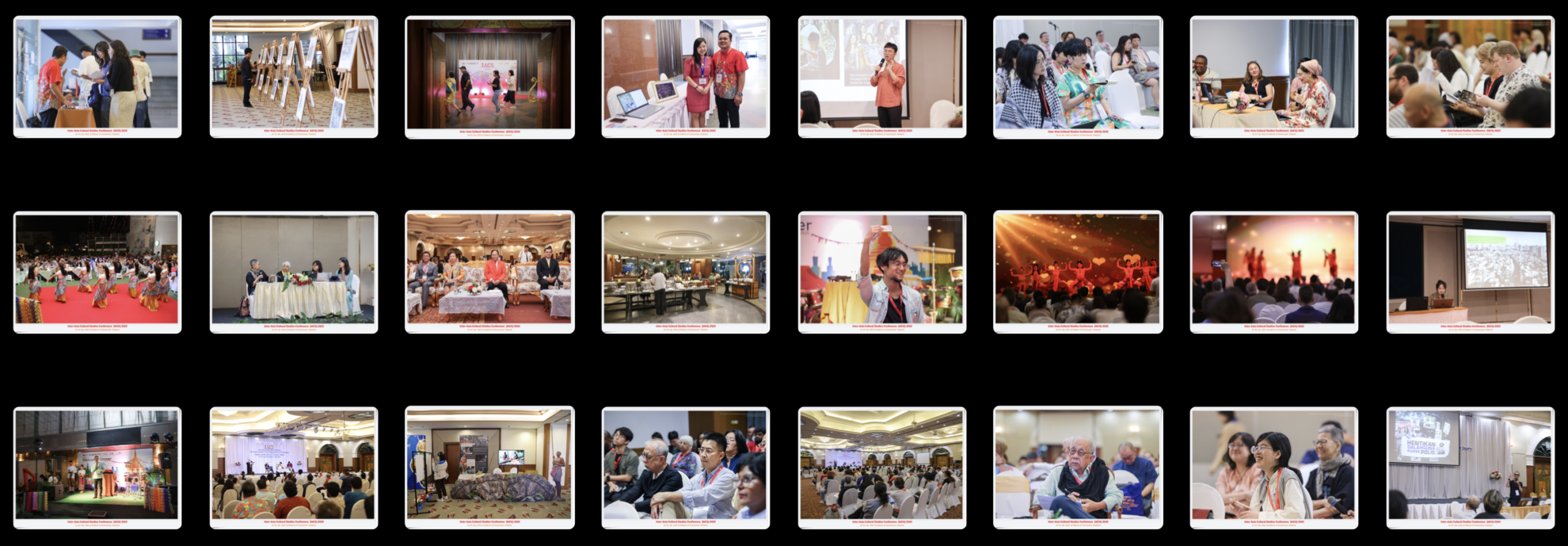
Photos by Photoandvdo Clm Wu
—
It has been a little over six months since we said our goodbyes to new and old friends after the 2025 IACS conference held over the course of three days in Nakhon Si Thammarat in southern Thailand. Every edition of our biennial conference is both familiar and unique: familiar because of the friends we are happy to see again; unique as, each time, we are welcomed to different places with their own tones and textures, shaping our points of reference, dialogues, and community. Our conference hosts work not just to create a space for gathering. They curate the broader intellectual, social, cultural, and (not to forget) culinary contexts for these gatherings. The 2025 edition and its milieu prompted us, in the words of the organisers, “to reconsider how place itself shapes epistemic possibility, how peripheries unsettle centers, and how alternative regional imaginaries come into being” (Somboonboorana et al. 2026: 3). The historical geography and peripheral positionality of Nakhon Si Thammarat—also referred to as Muang Khon (City of People), reflecting the lived history of its diverse populations—foreground it as a site where “subjugated perspectives” and intercultural exchanges occur outside of hegemonic frameworks. It provided a potent context in which to explore how geo-social connections could be formed under (de)global geopolitics and knowledge production (Ibid). In a recent publication in the Inter-Asia Cultural Studies journal (2026), the 2025 conference organisers reflect on their vision for the conference and on how it materialised in a unique space for encounter and connection, which emerged based on “shared atmosphere” (4).
—
Titled “Geo-social Connection: The Continuing Journey of Critical Inquiry,” and organised by the Center of Geosocial and Cultural Research for Sustainable Development (GSCR), the School of Political Science and Public Administration at Walailak University, and partner institutions across Thailand, the 2025 edition was intentionally “improvised, relational, and sometimes serendipitous, illuminating how knowledge production in Inter-Asia increasingly depends on encounters that exceed the formal architecture of the conference apparatus” (2). The organisers approached the event as a lived practice of geo-social connection—“an epistemic and affective condition” for the production, circulation, and experience of knowledge, situated in the unique context of Muang Khon. What emerged was a field of inquiry where “hierarchies softened” (6) and scholarly practice involved an “entanglement of thought and terrain, discourse and dwelling, critique and conviviality” (Ibid). What we can take away from the conference, as wonderfully put by the organisers, is that “[c]ritical inquiry flourishes when it attends to the textures of place, the complexities of people, and the unpredictable, transformative encounters that arise at their intersection” (Ibid). With that in mind, we look forward to seeing how different configurations of place, people, inquiry, and atmosphere take shape at the upcoming 2026 Inter-Asia Summer School, and the following 2027 Conference.
–
—
The organisers’ reflection on the conference was published in the Inter-Asia Cultural Studies journal (2026) as an introduction to a Special Issue that was prompted by the 2025 conference. The first 50 downloads of the article are free. The full piece may be accessed here:
—
Somboonboorana, S., Sawangchot, V., Peungcharoenkun, T., & Sittipat, T. (2026). Geo-social milieu of IACS 2025. Inter-Asia Cultural Studies, 1–7. https://doi.org/10.1080/14649373.2025.2610098
–
—
Also included in the Special Issue are the Guest Editors’ Note and three essays by the keynote speakers of the 2025 Conference:
—
Sawangchot, V., & Somboonboorana, S. (2026). Guest Editors’ Note. Inter-Asia Cultural Studies, 1. https://doi.org/10.1080/14649373.2025.2607202
—
Banerjee, P. (2026). Technology and the limits of cultural critique. Inter-Asia Cultural Studies, 1–15. https://doi.org/10.1080/14649373.2025.2610099
—
Gaweewong, G. (2026). Exhibition as method: rethinking the cartography of trans-Asia. Inter-Asia Cultural Studies, 1–17. https://doi.org/10.1080/14649373.2025.2606633
—
Matsumura, W. (2026). Expropriated life, class struggle, and the colonial relation along Okinawa’s fence-line. Inter-Asia Cultural Studies, 1–15. https://doi.org/10.1080/14649373.2025.2610103 (Open Access)